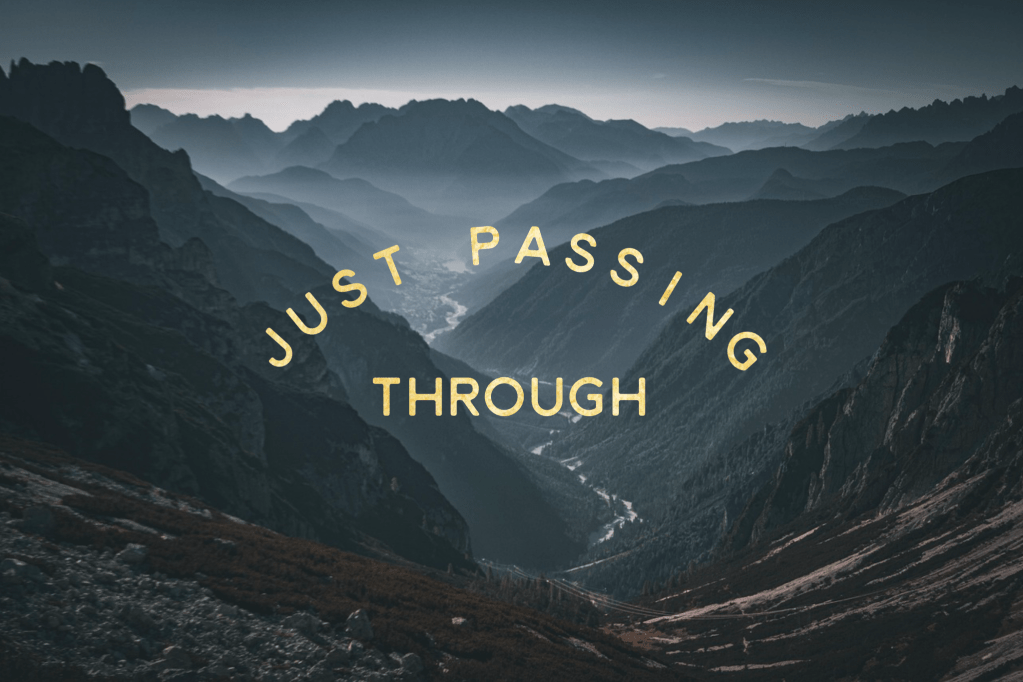
I’ve been thinking a lot about valleys this week. Feeling like I’m in one; walking through one. Wanting to reflect, be curious and aware, and try to define it. What kind of valley is it this time?
I’m familiar with valleys: physical and spiritual, literal and metaphorical. Over the past 17 years, we’ve lived mostly in valleys; four geographical ones to be exact. Check out my blog Valley after Valley for more on that. (I’ve lost count of how many spiritual/metaphorical ones.)
At Rhythm Church last Sunday, Pastor Jeff mentioned the Valley of Baca:
“Blessed are those whose strength is in you, in whose heart are the highways of Zion. As they go through the Valley of Baca they make it a place of springs; the early rain also covers it with pools. They go from strength to strength; each one appears before God in Zion.”
– Psalm 84:5-7
In Hebrew, bāḵā’ means “weeping, lamentation; the valley of weeping, or of lamentation, of a valley in Palestine, so called from some reason connected with its name; probably gloomy and sterile.” It was part of their pilgrimage to journey through the valley of weeping, the place of lamentation. And what did they do when they passed through the Valley of Baca? It doesn’t say that they camped there or outstayed their welcome. They made it a place of springs, of fountains, as they journeyed through. They transformed the valley, bringing water and life; they changed the landscape. Maybe it was through joy; maybe it was through honest reflection, sorrow, and vulnerability. Either way, they moved from strength to strength.
In May 2017, I wrote an extended blog about valleys and mountains (you can find it here). Toward the end of that blog, I highlighted the Valley of Achor. It was known as a valley of trouble or disaster (Joshua 7). But the Lord declared that He would make it a door of hope (Hosea 2:15). I love how Isaiah 65:10 refers to it: “Sharon will be a pasture land for flocks, and the Valley of Achor a resting place for herds, for My people who seek Me.”
This is what God can do. The places that once caused sorrow will bring hope; the areas that stirred up trouble will become a space for rest.
The word for valley in these passages is ʿēmeq, and it means “a vale (i.e. a broad depression); a valley, a low tract of land of wide extent.”
I also mention Psalm 23:4 in that blog, the well-known verse about the valley of the shadow of death. This specific valley is very steep. The Hebrew word used here is gay’: “a gorge (from its lofty sides; hence, narrow, but not a gully or winter-torrent), a valley, so called from the water flowing together there; hence, a low, flat region.” This valley is not only steep; it’s also marked by darkness. The word for the shadow of death is ṣalmāveṯ; it means “shade of death, i.e. the grave (figuratively, calamity); very thick darkness.” A deep pit, the shade of death itself. Like a grave.
I know there are a lot of Hebrew definitions in this post, and I don’t have time to dig into them all, but I wanted to share a couple facts about two other famous valleys in the Bible.
The Valley of Dry Bones (Ezekiel 37) uses a different word for valley, biqʿâ, meaning “properly, a split, i.e. a wide level valley between mountains.” This is the visual I have when I think of a valley – a split, a wide space nestled in between two mountains. It was here in this place that the dried up bones were gathered.
Another interesting valley – David fought Goliath in the Valley of Elah. This valley is described as ʿēmeq AND gay’ in different verses. It can be wide AND narrow, steep AND flat. Valleys can be described in more ways than one, and seem to contradict itself.
It’s interesting to me that many of the valleys in Scripture have negative connotations: valley of weeping, of trouble, of deep darkness/shadow of death, giants, dry bones, etc. And almost always, there is a transformation waiting on the other side of the valley, a different ending to the story. Refreshing and strength, hope and vindication, victory and life.
Maybe you’re in a valley right now. If you could name it, what would you call it? What is this valley marked by? And what hope can you cling to? What promise can you tether your heart to as you pass through that valley?
May we keep our eyes fixed on God and follow His lead in the valleys. And may we have eyes to see how God might transform the valley while we’re still in it.
 My Race to Run